
Aphorisms and Idioms: A Clean Slate

 S
S
tarting with “a clean slate” is thought to be the oldest known idiom. It means a fresh beginning, one free of past mistakes or failures.
These days, you might use this idiom to say something like, “my divorce really hit me hard, so I’m relocating to start over with a clean slate.” Or perhaps, “Bobby ran into some issues at his previous school, so his folks have enrolled him elsewhere, allowing him to start with a clean slate.” Or even, “everyone makes mistakes, but give yourself permission to start again with a clean slate.”
It All Started With
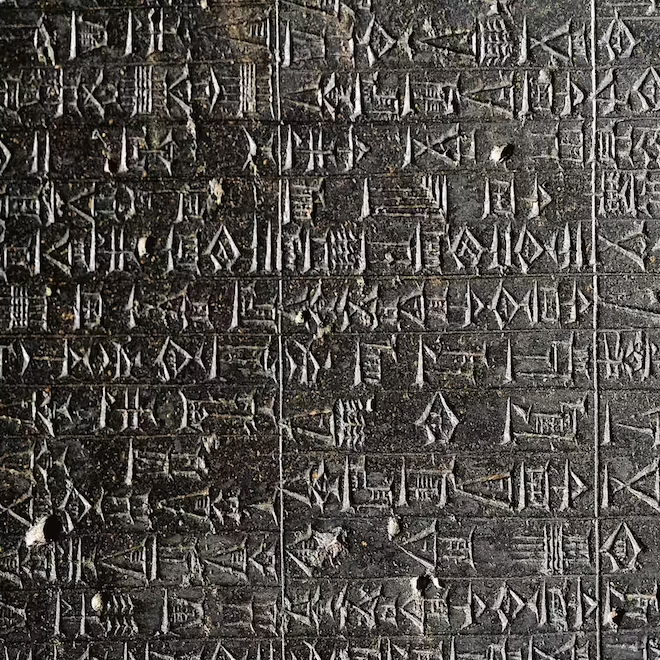
The Code of Hammurabi
The idiom “starting with a clean slate” originates from the treatment of debt in the Code of Hammurabi (one of the earliest written legal codes), from about 1800 BC. If you were unable to repay a debt due to circumstances beyond your control, a hailstorm flattened your fields of grain for example, your debt could be cancelled. An early form of bankruptcy, if you will.
What does that have to do with a clean slate? Well… back in the Babylonian days, debts were recorded on clay tablets. And in the event of a debt-cancelling scenario like the one mentioned above, the clay tablet recording your debt would be “washed.” That is, dissolved in water. As a result, you would start the next growing season with a fresh, new, “clean slate,” one with no indication of your previous debt.[1]
During the Greco-Roman period, wax tablets were commonly utilized. The blunt end of a stylus was used to erase mistakes. And a slate could be “cleaned” by holding it close to a flame until the wax was soft enough to smooth out to its original state. [2]
Around the 11th century, personal writing tablets made of slate began to appear. And as anyone familiar with the Little House on the Prairie series can tell you, they became a universal tool in the one-room school-houses prevalent during the pioneer-era. Written on with chalk, they were easily wiped clean with a cloth or sleeve.[3]
These days, we hit delete on our computers. But regardless of how we return to a “clean slate,” everyone deserves a fresh start at one time or another.
Be Sure To Check Out More
Aphorisms And Idioms Here.

Endnotes:
[1] Drum, Kevin. “What is the oldest known idiom?” Mother Jones Daily. December 9, 2012.
[2] “The History and Use of Wax Tablets in Antiquity.” Donnagawell. October 10, 2024.
[3] “Pioneer Schools: One-Room Schoolhouses and Slates on the Frontier.” Laura Ingalls Wilder and Little House Books.
Images:
A Clean Slate: Photo by Kelly Sikkema on Unsplash
The Code of Hammurabi: Code of Hammurabi. History.com Nov. 9,2009

Share This Post, Choose a Platform!


Stay in the know about what’s in our ever-growing treasure trove of literary goodness. And, get your free Discover Everything a Book Has to Offer packet.
















Related Posts

Several idioms encourage us to be “nice,” including the adage “it’s nice to be important, but more important to be nice.” But “being nice” wasn’t always seen as a virtue. So what did it originally mean? And when did its meaning change? ... Read More
It’s impossible to literally “lift ourselves up by our bootstraps.” And yet, the phrase is commonly used to encourage us to power through challenges with hard work. So how did an impossible task become a call for individual grit? ... Read More

Being able to read between the lines is a valuable skill. And this idiom has roots in the centuries-old world of secret communication. How can reading between the lines benefit you?... Read More

Flying by the seat of your pants. What does this idiom mean? Where did it come from? And how far can doing so take you? ... Read More