

Aphorisms and Idioms: The Writing Is On The Wall

 T
T
he idiom “the writing is on the wall” isn’t about graffiti, Egyptian hieroglyphics, or the stencils above Grandma’s family pictures. It’s an expression that means you can see a particular turn of events coming – invariably something bad.
For example… Bob recently lost his company’s biggest client, and now the writing is on the wall about his continued employment in the firm. Which is to say, it’s clear that very soon Bob will no longer be employed at his current place of business.
Origin Of The Idiom
The Writing Is On The Wall
The phrase originates from the Old Testament book of Daniel. Babylonian king Belshazzar has hosted a lavish feast, during which a disembodied hand appears and inscribes a message on the palace wall.
Unable to decipher its meaning, Belshazzar summons the prophet Daniel who interprets the missive as a divine verdict. Daniel tells the king that his days are numbered. His reign has been weighed and found wanting. And that Belshazzar’s kingdom will be divided among the Medes and Persians.
That very night Belshazzar is slain. Babylon falls. And Darius of Mede takes over the kingdom. This episode establishes the core imagery of a metaphor that has come to mean any evident harbinger of downfall or failure.
One of the earliest printed records of its use as an idiom occurred in 1638, when Captain L. Brinckmair’s The Warnings of Germany likened observations about the Thirty Years War to the Biblical story.
In 1720, Jonathan Swift used it in his poem The Run Upon the Bankers. In swift’s poem “Tis like the Writing on the Wall” portrays a banker foreseeing his own financial ruin.
Over the centuries, this idiom has clearly broadened to secular contexts, including economic collapse, political instability and personal downfall.[1]
I’m Looking At You,
King George
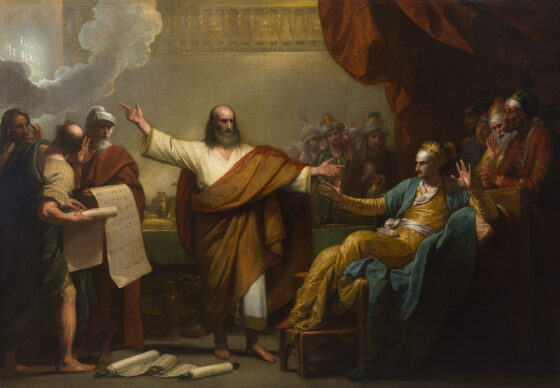
Which brings us to Benjamin West’s painting Daniel Interpreting to Belshazzar the Writing on the Wall. West was the official historical painter to Britain’s King George III. And he painted this work in 1775, when the British empire was coming increasingly closer to civil war. The painting depicts the story of Daniel mentioned above, as he is interpreting the message on the wall to King Belshazzar.
See where this is heading?
West had embedded political meanings in this piece. And in 1776, he showed it at London’s most prominent annual exhibition. His hope was that Daniel’s warning to a prideful king would resonate with King George III, and that he would act diplomatically rather than punitively toward the American colonists.[2]
But the writing was already on the wall, and the rest is American history.
Be Sure To Check Out More
Aphorisms And Idioms Here.
Aphorisms And Idioms Here.

Endnotes:
[1] “The writing is on the wall.” The Idioms. February 28, 2026.
[2] St Louis Art Museum. Picturing Independence Exhibition.
Images:
The Writing Is On The Wall: Photo by Davide Valerio on Unsplash
Origin of The Writing Is On The Wall: Photo by Duncan Kidd on Unsplash
Benjamin West. Daniel Interpreting to Belshazzar the Writing on the Wall: St. Louis Art Museum

Share This Post, Choose a Platform!


Stay in the know about what’s in our ever-growing treasure trove of literary goodness. And, get your free Discover Everything a Book Has to Offer packet.

















Related Posts

L ike many mothers, my mom drilled the importance of being nice into my young psyche. She used expressions like the direct and simple... Read More.

It’s impossible to literally “lift ourselves up by our bootstraps.” And yet, the phrase is commonly used to encourage us to power through challenges with hard work. So how did an impossible task become a call for individual grit? ... Read More

Being able to read between the lines is a valuable skill. And this idiom has roots in the centuries-old world of secret communication. How can reading between the lines benefit you?... Read More

Flying by the seat of your pants. What does this idiom mean? Where did it come from? And how far can doing so take you? ... Read More