

Beloved:
The Very Real Haunting Of Trauma

 T
oni Morrison said in order for “the slave experience” that she explores in Beloved to be intimate, “language must get out of the way.”[1] That’s quite an ironic thing for a writer to say. So, how does that work?
In order to “render enslavement as a personal experience,” Morrison made the work’s titular character a ghost. One who is the catalyst for a pervasive sense of things “being both under control and out of control.”[2] As well as the violent disruption of everyday life “by the chaos of the needy dead.”[3] Embodying the memory desperate to stay alive, threatening “the herculean effort to forget.”[4]
Doing so, Morrison echoes the very real psychological repercussions of trauma, showing how the past continues to haunt the present. In this case, the lingering effects of slavery, personal loss, and collective suffering — of the more than sixty million victims of slavery to whom Beloved is dedicated.
Beloved was published at a time when trauma theory was just beginning to emerge as a distinct interdisciplinary field. And Morrison’s work anticipates many of the concepts that would become formalized in theoretical and clinical dialogue.
The novel’s non-linear narrative structure, representation of embodied traumatic memory, and needless to say, use of the supernatural all function as symbolic language for the psychological effects of trauma.[5]
Beloved’s Inspiration
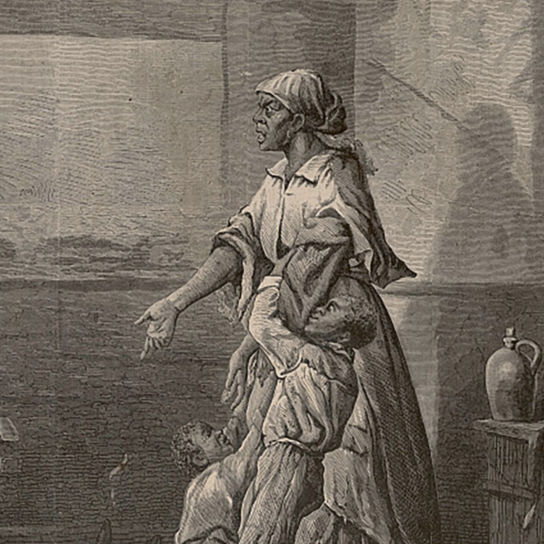
Morrison was famously inspired by the story of Margaret Garner. She was a young mother who had escaped slavery, and was arrested for killing one of her children (and attempting to kill the others) rather than see them returned to their enslaver’s plantation.
Beloved revolves around Sethe. Like Garner, Sethe is an escaped slave who kills her infant daughter in an effort to spare the baby’s capture by her former enslavers. Unlike Garner, however, she is not ultimately returned to her enslaver’s plantation.[6]
This book is the story of Sethe’s struggle with the traumatic memory of her actions, as well as those of the violent past that brought her to it.
While writing the novel, Morrison pondered a question that echoes one abolitionist and suffragist Lucy Stone Blackwell posed at the time of Garner’s trial:

If in her deep maternal love she felt the impulse to send her child back to God, to save it from coming woe, who shall say she had no right to do so?[7]
Morrison’s answer… “the only person who could decide whether [the killing] was a good thing or not, was the dead girl.”[8] So, a ghost called Beloved became an integral part of this story about the lingering effects of slavery, one who reacts “mournfully, desperately, lovingly, or furiously.”[9] What better way to convey the haunting sense of traumatic memory?

Traumatic Memory Refuses
To Become Part Of The Past
Morrison’s opening passage sets the scene. Characterizing the house as “spiteful,” and full of a baby’s venom. She makes it immediately clear that 124 Bluestone Road is haunted, dropping a very large hint about who is doing the haunting.[10]
She goes on to share examples of the specter’s activities. Such as overturning kettles full of simmering chickpeas onto the kitchen floor. Spreading cracker crumbs next to the doorsill. Or moving large pieces of furniture across the room.
Then there are the incidents that drove Sethe’s sons, Buglar and Howard, from the house by the time they were thirteen years old. The shattering of a mirror when Buglar looked into it. And the two tiny handprints Howard witnessed appearing in a freshly baked cake.
Paul D senses the haunting as soon as he steps through the door. It took the form of “a pool of red and undulating light that locked him where he stood.” Significantly, Sethe makes it clear that this “company” isn’t evil, “just sad.[11]
The haunting of 124 Bluestone Road echoes Bessell van der Kolk’s concept that:
Being traumatized means continuing to organize your life as if the trauma were still going on—unchanged and immutable—as every new encounter or event is contaminated by the past. [12]
Consistent with van der Kolk, Sethe’s life continues to be organized around the “company” that haunts her. Unlike her sons, she remains (along with her living daughter Denver) embedded in a house “palsied by the baby’s fury at having its throat cut.”[13] A home inundated with Sethe’s guilt and grief, as well as memories of the violence she endured during enslavement. Morrison sums it up by telling the reader that, “to Sethe, the future was a matter of keeping the past at bay.”[14]
As van der Kolk also notes, new events are contaminated by the past as well. Like the day Mr. Bodwin drove his cart down Bluestone Road to pick up Denver for her first day of work.
But Sethe didn’t see Mr. Bodwin. As she stood on the porch alongside Beloved’s now manifested form, what Sethe saw was the arrival of Schoolteacher. The enslaver who had come to return her and her children to slavery on the day Sethe “sent Beloved back to God.”
And if she thinks anything, it is no. No no. Nonono. She flies. [An] ice pick is not in her hand; it is her hand.[15]
Though Sethe gets right up to Mr. Bodwin, the group of women who had gathered in front of her house that day manage to prevent her from stabbing him. After the dust has settled as the expression goes, Stamp cracks wise to Paul D, joking that:
Every time a whiteman come to the door she got to kill somebody?[16]
Though Stamp’s remark was made in sardonic jest, it reflects the way unresolved trauma can rear its head in new, entirely innocent situations like the one involving Mr. Bodwin.

The Effects Of
Fragmented Storytelling
Another way Morrison “render[s] enslavement as a personal experience,” is with a combination of non-linear narrative structure and fragmented storytelling. As she explicitly states in the book’s forward:
I wanted the reader to be kidnapped, thrown ruthlessly into an alien environment as the first step into a shared experience with the book’s population—just as the characters were snatched from one place to another, from any place to another, without preparation or defense.[17]
As Morrison points out, her choice of narrative structure is not simply aesthetic. Its purpose is to give the reader a taste of what enslaved persons felt when they were abruptly pulled out of a place and dropped into another.
Beloved continuously shifts between time periods, blurring the boundary between the past and the present. Fragmented storytelling adds to the intended disorientation. The best example of this is the story of Sethe’s most dehumanizing experience while enslaved. The episode when Schoolteacher’s nephews hold Sethe down and take her breast milk is delivered across multiple narrative moments, rather than as a coherent sequence.[18]
The demands these literary devices make on the reader replicates those that traumatic material makes on consciousness. Specifically, the fragmented memory, and shifting temporal sense that characterizes post-traumatic stress[19]
Rememory:
Embodied Traumatic Memory
And Transmitted Traumatization
We’re introduced to Morrison’s concept of rememory in a conversation Sethe has with Denver about why it’s difficult for her to believe in time. By adding the prefix “re-“ to the word memory, Morrison indicates a cyclical encounter with a trauma that just won’t stay buried in the past.[20]
The conversation between Sethe and Denver anticipates van der Kolk’s thinking about traumatic experiences as embodied phenomena. As well as Natan Kellermann’s contention that traumatization doesn’t only affects those directly exposed to it, but can be transmitted to those around them.
Some things go. Pass on. Some things just stay. I used to think it was my rememory. You know. Some things you forget. Other things you never do. But it’s not. Places, places are still there. If a house burns down, it’s gone, but the place – the picture of it – stays, and not just in my rememory, but out there, in the world.[21]
In other words, embodied memory. Morrison’s observation parallels van der Kolk’s thinking that traumatic experiences are not merely psychological in nature. That they leave deep imprints on our “biology and immune systems,” traces that are stored and reflected there long after the trauma occurs.[22]
In answer to Denver’s question about whether other people can see this rememory, Sethe goes on to say:
Oh, yes. Oh, yes, yes, yes. Someday you be walking down the road and you hear something or see something going on. So clear. And you think it’s you thinking it up. A thought picture. But no. It’s when you bump into a rememory that belongs to somebody else… The picture is still there and what’s more, if you go there – you who never was there – if you go there and stand in the place where it was, it will happen again; it will be there for you, waiting for you.[23]
This aspect of rememory parallels what Natan Kellermann refers to as “transmitted traumatization.” [24] And we see it in Denver, who carries the traumatic inheritance of Sethe’s history:
All the time, I’m afraid the thing that happened that made it all right for my mother to kill my sister could happen again. I don’t know what it is, I don’t know who it is, but maybe there is something else terrible enough to make her do it again. I need to know what that thing might be, but I don’t want to. Whatever it is, it comes from outside this house, outside the yard, and it can come right on in the yard if it wants to. So I never leave this house and I watch over the yard, so it can’t happen again and my mother won’t have to kill me too.[25]

Trauma Doesn’t
Let Go Easily
As professor of psychiatry Judith Lewis Herman notes, recovery can’t occur in isolation – only within the context of relationships. Renewed connections with other people allow the trauma survivor to recreate the psychological faculties that have been damaged or deformed by the traumatic experience. [26]
But trauma doesn’t let go easily. So, it’s no coincidence that Beloved appears in physical form while Sethe, Denver, and Paul D are at enjoying themselves at the carnival.
Paul D offers a safe relationship, the kind that could help Sethe heal. Once, Sethe had been soft, and trusting. Paul D “dug that up.”[27] And on the way home from the carnival, Sethe caught sight of the fact that:
They were not holding hands, but their shadows were. Sethe looked to her left and all three of them were gliding over the dust holding hands. Maybe [Paul D] was right. A life… Nobody noticed but Sethe and she stopped looking after she decided that it was a good sign. A life. Could be. [28]
As long as Sethe remained trauma-bound to the past, Beloved was happy to simply haunt the house in the typical way. But no sooner does Sethe begin to believe in the possibility of putting the past to rest, when the ghost gets serious. And is waiting in physical form (at the age she would be if she had lived) on the front lawn when the threesome returns from the carnival.
Beloved does everything she can to draw Sethe back into the deadened, hopeless condition that allows them to be together. And it works. She’s back in the thick of traumatic memory, deeper than ever before, steeped in grief and guilt:
She come back to me of her own free will and I don’t have to explain a thing. I didn’t have time to explain before because it had to be done quick. Quick. She had to be safe and I put her where she would be. But my love was tough and she back now. I knew she would be. Paul D ran her off so she had no choice but to come back to me in the flesh… I’ll tend her as no mother ever tended a child, a daughter.[29]
The relationship with Paul D that opened the door to Sethe’s recovery is destroyed. She is now convinced that the hand-holding shadows she had seen on the way home from the carnival were not Paul D, Denver, and herself. But herself, Denver, and Beloved.
Sethe now feels she was right all along, that:
there is no world outside my door. I only need to know one thing. How bad is the scar? [30]
And she deteriorates to a condition Denver describes as “[sitting] around like a rag doll, broke down, finally, from trying to take care of and make up for.[31]

Community Healing
Beloved is, of course, the daughter Sethe killed rather than see her taken back to the plantation they had escaped from. And she’s the literary device Morrison employs to render enslavement as a personal experience. But Beloved also represents the collective suffering and memory of countless victims of slavery.
When Beloved narrates her own story, she relates memories that have nothing to do with Sethe or Denver. Memories that recall the Middle Passage – the journey from Africa to the Americas enslaved people were forced to make:
All of it is now it is always now there will never be a time when I am not crouching and watching others who are crouching too I am always crouching the man on my face is dead his face is not mine his mouth smells sweet but his eyes are locked…
the little hill of dead people a hot thing the men without skin push them through with poles the woman is there with the face I want the face that is mine they fall into the sea which is the color of the bread…
now there is room to crouch and to watch the crouching others it is the crouching that is now always now inside the woman with my face is in the sea a hot thing [32]
And as she stands on the porch with Sethe on the day Mr. Bodwin arrives to pick up Denver for her first day of work, Beloved is pregnant. Her pregnancy symbolizes the transmitted trauma of yet another generation.
So, the fact that Beloved is returned to a place beyond the veil through the actions of a group of previously enslaved people is significant. Those who had also endured slavery, and “been beaten every way but down.”[33] The aforementioned group of neighborhood women who had gathered to pray in front of 124 Bluestone Road, chanting, in wordless primal fashion.
In the midst of the skirmish that prevents Sethe from stabbing Mr. Bodwin, Beloved simply vanishes as the chanting peaks. The house at 124 Bluestone Road is quiet now, and the sad red light no longer bathes the entryway.
That is not to say that Beloved and the trauma she embodies has been eradicated.
Down by the stream in back of 124 her footprints come and go, come and go. They are so familiar. Should a child, an adult place his feet in them, they will fit. Take them out and they disappear again as though nobody ever walked there. [34]
In other words, the trauma embodied by Beloved has been processed, and rendered ordinary memories. These events still occurred, of course, but traumatic memory no longer controls the lives of those who experienced them. They are now able to step out of those footprints.

In Conclusion
It goes without saying that Beloved is a masterful, and yes… haunting piece of literature (in more than one sense of the word). But its enduring relevance lies in the fact that Morrison refuses to let slavery-related trauma become history in the comfortable sense. As something over and done with. A closed chapter if you will.
Morrison’s Beloved stands firm in its intention that slavery’s traumatic legacy remains alive. It’s inscribed in bodies, families, and communities in ways that demand not only acknowledgement but response. Which converges with trauma psychology’s commitment to the necessity of bearing witness to what has been endured. Otherwise, there can be no healing. Not for individuals suffering from traumatic memory, or our nation itself.
That’s Our Take On
Toni Morrison’s Beloved. What’s Yours?
Here’s A Discussion Guide To Get You Started
Pair This With


Share This Post, Choose a Platform!
Endnotes:
[1] Morrison, Toni. Beloved. New York: Vintage Books, 2004.Pgxix
[2] Morrison, Toni. Beloved. New York: Vintage Books, 2004.Pgxix
[3] Morrison, Toni. Beloved. New York: Vintage Books, 2004.Pgxix
[4] Morrison, Toni. Beloved. New York: Vintage Books, 2004.Pgxix
[5] Dr. Asma Jeelani Chishti. “The Psychology of Trauma in Toni Morrison’s Beloved.” Journal of Advances and Scholarly Research in Allied Education. Vol. 23. Issue No. 2. April 2026. Pg 362.
[6]Basset, P.S. “A Visit to the Slave Mother who Killed Her Child.” Fairmont Theological Seminary, Cincinnati, Ohio. Feb 12, 1856.
Yanuck, Julius. “The Garner Fugitive Slave Case.” The Mississippi Valley Historical Review. Vol. 40, No 1 (June 1953), pp 47-66.
[7]Coffin, Levi. Reminiscences of Levi Coffin, the reputed president of the Underground railroad. Cincinnati: R. Clarke & Col, 1880. Pg 565
[8] Gross, Rebecca. “Toni Morrison, on How ‘Beloved’ Came to Be.” National Endowment for the Arts. Feb 09, 2015
[9] Gross, Rebecca. “Toni Morrison, on How ‘Beloved’ Came to Be.” National Endowment for the Arts. Feb 09, 2015
[10] Morrison, Toni. Beloved. New York: Vintage Books, 2004.Pg 3
[11] Morrison, Toni. Beloved. New York: Vintage Books, 2004.Pg 10
[12] Van der Kolk, Bessell. The Body Keeps the Score: Brain, Mind, and Body in the Heling of Trauma. New York: Viking Press, 2014. Pg 64
[13] Morrison, Toni. Beloved. New York: Vintage Books, 2004.Pg 8
[14]Morrison, Toni. Beloved. New York: Vintage Books, 2004.Pg 51
[15] Morrison, Toni. Beloved. New York: Vintage Books, 2004.Pg 309
[16] Morrison, Toni. Beloved. New York: Vintage Books, 2004.Pg 313
[17] Morrison, Toni. Beloved. New York: Vintage Books, 2004.Pg viii
[18] Dr. Asma Jeelani Chishti. “The Psychology of Trauma in Toni Morrison’s Beloved.” Journal of Advances and Scholarly Research in Allied Education. Vol. 23. Issue No. 2. April 2026. Pg 364.
[19] Dr. Asma Jeelani Chishti. “The Psychology of Trauma in Toni Morrison’s Beloved.” Journal of Advances and Scholarly Research in Allied Education. Vol. 23. Issue No. 2. April 2026. Pg 370.
Herman, Judith Lewis. Trauma and Recovery. Basic Books, 1992. Pg 37
[20] “Rememory Toni Morrison: The Haunting Power of Collective Memory (Analysis).” Sensazioni.org April 28, 2026.
[21] Morrison, Toni. Beloved. New York: Vintage Books, 2004.Pg 43
[22] Dr. Asma Jeelani Chishti. “The Psychology of Trauma in Toni Morrison’s Beloved.” Journal of Advances and Scholarly Research in Allied Education. Vol. 23. Issue No. 2. April 2026. Pg 363.
Van der Kolk, Bessell. The Body Keeps the Score: Brain, Mind, and Body in the Heling of Trauma. New York: Viking Press, 2014. Prologue.
“How the Body Keeps the Score and Neuroscience of Trauma in the Body.” Psychotrauma Knowledge Base.
[23] Morrison, Toni. Beloved. New York: Vintage Books, 2004.Pg 43-44.
[24] Kellermann, Natan “Transmission of Holocaust Trauma – An Integrative View.” Psychiatry. Fall 2001 Vol. 64 Issue 3. Pg 257.
[25] Morrison, Toni. Beloved. New York: Vintage Books, 2004.Pg 242.
[26] Herman, Judith Lewis. Trauma and Recovery. Basic Books, 1992. Pg 133
[27] Morrison, Toni. Beloved. New York: Vintage Books, 2004.Pg 222
[28] Morrison, Toni. Beloved. New York: Vintage Books, 2004.Pg 56-57
[29] Morrison, Toni. Beloved. New York: Vintage Books, 2004.Pg 236
[30] Morrison, Toni. Beloved. New York: Vintage Books, 2004.Pg 217
[31] Morrison, Toni. Beloved. New York: Vintage Books, 2004.Pg 286.
[32] Morrison, Toni. Beloved. New York: Vintage Books, 2004.Pg 248-
[33] Morrison, Toni. Beloved. New York: Vintage Books, 2004.Pg 305.
[34] Morrison, Toni. Beloved. New York: Vintage Books, 2004.Pg 324
Images:
Beloved’s Inspiration: “The Modern Medea.” Harper’s Weekly. May 18, 1867
Traumatic Memory Refuses To Become Part Of The Past: Photo by Tom Frances Palattao on Unsplash
The Effects Of Fragmented Storytelling: Photo by Peyman Farmani on Unsplash
Rememory: Photo by Anita Jankovic on Unsplash
Trauma Doesn’t Let Go Easily: Photo by Jr Korpa on Unsplash
Community Healing: Photo by Mario Purisic on Unsplash
Beloved In Conclusion: Photo by Azzedine Rouichi on Unsplash

Share This Post, Choose a Platform!


Stay in the know about what’s in our ever-growing treasure trove of literary goodness. And, get your free Discover Everything a Book Has to Offer packet.


















Related Posts

George M. Johnson's memoir All Boys Aren’t Blue has been characterized as obscene. Here’s a breakdown of why that’s sheer nonsense.... Read More
R ay Bradbury’s iconic dystopian work Fahrenheit 451 offers compelling insights into today’s epidemic of book banning. The progression of events within the text... Read More.

Thomas Morton’s blistering satire The New English Canaan was the first book banned in the United States. Learn more about it here.... Read More

Banned due to the social issues it addresses, Cisneros' work tells the culturally significant story of Esperanza as she comes of age in the Hispanic quarter of Chicago.... Read More