To Kill a Mockingbird: An Uncomfortable Look Under the Pages
 T
T
o Kill a Mockingbird by Harper Lee is frequently touted as one of the best novels of the 2oth century.[1] But it’s also one of the most controversial. So, I suppose it should come as no surprise that this book has a long history with censorship.
One of the most recent challenges To Kill a Mockingbird has faced is also one of the vaguest. It was levied simply because the Pulitzer Prize winning novel “makes people uncomfortable.”[2]
But is that really a bad thing? The injustices Tom Robinson faces in Lee’s work should hit readers right in the gut. Being uncomfortable with those injustices indicates that our conscience is functioning properly.
The liberal peppering of the N-word throughout the novel should also make us feel uncomfortable. It’s a heinous word, used to cause discomfort for four hundred years.
It’s important to note that when an author uses questionable language, depicting it doesn’t mean they’re endorsing it. Books like Harper Lee’s, that address social issues whatever they may be, include such language as a means of calling out the injustice in question. In this case prejudice and the racial oppression it leads to.
Avoiding it completely robs students of the opportunity to learn about the history of the N-word, where it came from. The gravity of that word. And perhaps most importantly, why it shouldn’t be used. I mean, really why it shouldn’t be used – beyond the fact that it simply makes people uncomfortable.
It’s very much like weeding a garden. You can’t just snip the offending growth off at ground level. Doing so may temporarily give your garden a weed-free appearance. But if you want to actually eradicate the weeds in your garden, they need to be pulled roots and all from the earth.

The Past Will Remain Horrible
For Exactly As Long As We Refuse To Assess It Honestly
Books that address race have been banned in classrooms and scrubbed from school curriculums under legislation like Florida’s Stop WOKE Act because the difficult history surrounding this issue may make students feel “discomfort, guilt, or anguish.”[3]
As James Baldwin observed:
Neither whites nor blacks, for excellent reasons of their own, have the faintest desire to look back.[4]
Baldwin further states, however, that:
…the past is all that makes the present coherent, and further, that the past will remain horrible for exactly as long as we refuse to assess it honestly.[5]
Scholar Dr. Eddie Glaude Jr. unpacks Baldwin’s remarks, noting that failure to assess the past inflicts damage upon all of us. If we don’t confront history honestly, Dr. Glaude observes, “we will always be on the cusp of being monstrous.”[6]
And, he insightfuly points out, we won’t be able to release ourselves into the future unless we confront history and tell ourselves the truth about the past.[7] And yes, doing so is sure to bring about some discomfort.
Shining Light Into
The Darkness Of Our Own Ignorance
As middle-school educator Christina Torres notes in Education Week, the very act of education entails “shining light into the darkness of our own ignorance.” Adding “When has that ever felt good?” [8]
Exercising your brain is no different than working out in the gym… no pain, no gain, as the saying goes.
The most important thing to consider when teaching books like To Kill a Mockingbird is to create a safe space for students to discuss these matters. And there’s a big difference between a safe space and a bubble.
In a safe space students can feel comfortable about themselves and engage in difficult conversations in a way that validates as well as challenges each other in healthy ways. Find a few pointers from American Educator on creating safe spaces here.
A bubble, on the other hand, simply hides students from the world’s problems, leaving them ill-prepared to face the future.

Atticus Finch:
White Savior
There are some valid critiques of To Kill a Mockingbird, concerning the fact that Atticus Finch is seen as a white savior figure. This turn of events is likely due, at least in large part, to the book having been written by a person of European descent… i.e. a white person. And that the story is told from the same perspective.
What is white saviorism? It refers to the notion that people of color must be “helped” or “rescued” by white communities or individuals because they are somehow not capable of helping or rescuing themselves. As I’m sure you can imagine, it’s another issue that makes some people uncomfortable, if not downright angry. Understandably so.
But is it grounds for banning To Kill a Mockingbird? Needless to say, white saviorism is another weed that needs to be eradicated from our proverbial garden. And that requires discussion about the difference between it and genuine allyship. An honest exchange that educates those in need of learning the difference between the two.
Books written by people of color, from a person of color’s perspective, about their experiences are essential to that exchange. Because as anti-racism consultant Nova Reid writes in The Guardian:
We’ve been revolting, rescuing ourselves and rising up, in spite of systemic oppression, for centuries. We’ve had no choice but to, for our own self-preservation and survival.[9]
We need to hear those stories too. Books about the Harlem Renaissance like The Blacker the Berry by Wallace Thurman, for example, Maya Angelou’s poetry, or any of young adult author Jason Reynolds’ novels. And that’s just for starters.

In Conclusion
To Kill a Mockingbird is a classic piece of literature. That is not to say it’s a perfect novel. And we’ve noted a couple of its valid critiques. But literature isn’t intended to be placed on a pedestal, as the saying goes. We’re meant to look under a book’s pages and between the novel’s characters, as well as find the work’s gaps.
Because what the author doesn’t say reveals as much about society as anything they explicitly address — maybe even more. And pointing out those gaps opens the door to a discussion about what the work fails to address.
Banning this book because it makes some students uncomfortable completely misses the point. The discomfort is, in fact, the point. The unease that arises in students from reading Lee’s novel is an entry point to engage them in critical anti-racism dialogue.
As educator Lorena German maintains, To Kill a Mockingbird is a useful narrative to use as a springboard for discussing the post-Reconstruction south’s racial context. Or teaching about Emmett Till, the Scottsboro Boys, and other real-life events that connect to falsely-accused Tom’s circumstances.[10]
Literature is more than pleasant stories written to entertain us. Its purpose is to make a statement about issues within the society that produced it. So, things are probably gonna get a little uncomfortable. And that’s a good thing. Because, having confronted history honestly, we can channel that discomfort into building a better future for ourselves and others.

Share This Post, Choose A Platform!
Endnotes:
[1] “’To Kill A Mockingbird’ remains among top banned classical novels. PBS.org https://www.pbs.org/newshour/education/to-kill-a-mockingbird-remains-among-top-banned-classical-novels
[2] Little, Becky. “Why ‘To Kill a Mockingbird’ Keeps Getting Banned.” History.com May 28, 2025. https://www.history.com/articles/why-to-kill-a-mockingbird-keeps-getting-banned
[3] Florida Bill 2022148. https://www.flsenate.gov/Session/Bill/2022/148/BillText/Filed/HTML
[4] James Baldwin. “Notes of a native son.” In Collected Essays. The Library of America, 1998. Pg 7.
[5] James Baldwin. “Notes of a native son.” In Collected Essays. The Library of America, 1998. Pg 7.
[6] “How Race Shadows the Nation’s Anniversaries.” John C. Danforth Center on Religion and Politics. April 9, 2026.
[7] “How Race Shadows the Nation’s Anniversaries.” John C. Danforth Center on Religion and Politics. April 9, 2026.
[8] Torres, Christina. “We Shouldn’t Always Feel Comfortable: Why ‘To Kill a Mockingbird’ Matters. October 15, 2017. Education Week. https://www.edweek.org/teaching-learning/opinion-we-shouldnt-always-feel-comfortable-why-to-kill-a-mockingbird-matters/2017/10
[9] Reid, Nova. “No more white saviours, thanks: how to be a true anti-racist ally.” The Guardian. September 19, 2021. https://www.theguardian.com/world/2021/sep/19/no-more-white-saviours-thanks-how-to-be-a-true-anti-racist-ally
[10] German, Lorena. “Disrupting ‘To Kill a Mockingbird.’” Disrupttexts.org https://disrupttexts.org/2018/05/13/disrupting-to-kill-a-mockingbird/
Images:
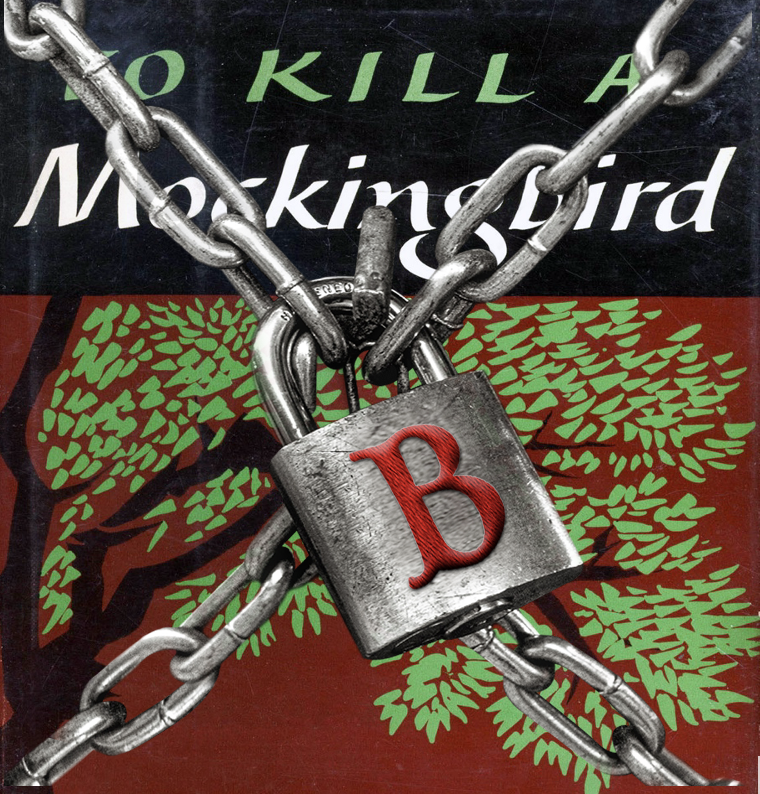
To Kill a Mockingbird 1st edition cover: Public Domain
The Past Will Remain Horrible: Photo by Mateusz Matusiak on Unsplash
Shining Light Into The Darkness of Our Own Ignorance: Photo by Mads Schmidt Rasmussen on Unsplash
White Saviorism: Publicity photo for To Kill a Mockingbird, Public Domain.

Share This Post, Choose a Platform!


Stay in the know about what’s in our ever-growing treasure trove of literary goodness. And, get your free Discover Everything a Book Has to Offer packet.






Related Posts
Banned due to the social issues it addresses, Cisneros' work tells the culturally significant story of Esperanza as she comes of age in the Hispanic quarter of Chicago.... Read More

Hispanic Heritage Month takes place every year from September 15th to October 15th. For those looking to celebrate with a book, we’re highlighting some challenged and banned titles written by Hispanic authors.... Read More

Censoring libraries is harmful to society. These letters serve to remind us what's at stake when state-sponsored censorship comes into play.... Read More

There have been more than 10,000 book challenges since 2021. Here are some tools for fighting book bans, and a few ways to resist censorship.... Read More